

A pool table is one of the most difficult household items we relocate. Its weight, bulky frame and delicate playing surface mean it cannot be handled like an ordinary piece of furniture.
Without the right approach, moving a pool table can result in torn felt, cracked slate, damaged timber, scratched flooring or personal injury. The safest method also depends on whether the table has a slate, timber or MDF bed.
In this guide, I’ll explain how to move a pool table, from measuring the access route and dismantling each component to packing, transport, reassembly and levelling. I recommend including the table in your broader moving house plan, so there is enough time to assess both properties.
Professional help is often advisable for slate tables, staircases, narrow access or long-distance moves. Experienced Perth removalists can inspect the table and route before moving day. At The Smooth Movers, we plan each stage carefully to protect your table, property and everyone involved.
Can You Move a Pool Table Without Taking It Apart?
In most cases, no. When I get clients asking how to move a pool table without taking it apart, I suggest disassembling the full-sized table before moving it.
An assembled table is very heavy, cumbersome and easily damaged. Raising it by the rails, pockets or legs can loosen connections, twist the frame or impact the playing surface. When tilted, dragged or rolled, it can also cause uneven pressure on the table and slate.
Occasionally, a small MDF or timber-bed model can be transported intact in areas where the route is flat and broad, and the distance is short. Regardless, I always check the manufacturer’s manual first. It may include model-specific instructions or restrictions.
If you are looking into how to move a slate pool table, it is normally safer to disassemble the table. The large and bulky nature of pool table moving is a challenge to control and more likely to cause awkward lifting positions.
At The Smooth Movers, we evaluate the table and assess the situation before deciding how to transport a pool table safely. Generally, the best thing to do when using slate models is to hire pool table movers in Perth.
| Table Type | Difficulty | Move Intact? | Professional Help Advised? |
|---|---|---|---|
| MDF or Timber Bed | Moderate | Sometimes | Depends on size and access |
| One-Piece Slate | Very High | Generally no | Yes |
| Three-piece slate | High | No | No |
Understand What Makes Pool Tables Difficult to Move
When people ask me how to move a pool table, I tell them that we’re not moving a regular table. A full-size table can be quite heavy, with slate tables being one of the heaviest.
More Than One Heavy Item
A pool table combines several important parts:
- Slate or another playing bed
- Timber or metal frame
- Rails and cushions
- Felt or cloth
- Legs and levelling components
Both parts contribute to the stability and playing accuracy of the table. The slate must be firmly even to stay level.
Parts of the individual slates are very heavy and easily broken even after the table has been dismantled. That’s why learning how to transport a slate pool table is more than just wrapping a pool table in a towel.
Access Changes Everything
Poorly chosen entry/exit points, close doorways, corners, and uneven surfaces can make moving a pool table very difficult.
Unexpected weight movement may cause someone to lose grip or be injured. Large, heavy and uneven loads take more force to lift and can put the body in an unusual position.
Equipment and Packing Materials You Will Need
Before moving a pool table, gather all the tools and protective packing materials. If you stop halfway to locate the proper drill bit or additional tape, heavy parts can be left unsupported.
Tool and Packing Checklist
- Socket set and spanners
- Screwdrivers
- Staple remover
- Power drill with suitable bits
- Labelled resealable bags
- Marker and masking tape
- Moving blankets
- Bubble wrap and packing paper
- Stretch wrap
- Strong packing tape
- Corner protectors
- Furniture dollies
- Lifting straps
- Timber or slate transport crates, where required
- Work gloves
- Closed-toe footwear
At The Smooth Movers, we take a picture of the table first and get everything off it. I also take close-ups of the pockets, rails, bolts and slate positions. These pictures can show how the parts are reassembled, making it easier.
Slate pool tables should always be transported using the correct crates and equipment when moving. Plan loads for mechanical aids, and use trolleys and barrows with extra help. The right moving equipment for the pool table is important to keep the game table safe and everyone handling it.
Measure the Table and the Moving Route
When moving a pool table, measure more than the table. Walk the entire route from where it is to the moving vehicle, and then repeat the process at the new property.
What to Measure
Record the width, length and height of the assembled table before dismantling it. At both properties, check:
- Doorways, hallways and gates
- Staircases, landings and tight corners
- Lifts and loading areas
- Low ceilings and outdoor steps
- Changes in floor level
- Vehicle access and parking spaces
Search for delicate floorings and make sure that any doors need to be temporarily removed. These checks are especially critical when it comes to apartments, multi-storey residences, and the like, where a single turn could alter the entire moving strategy for the pool table.
Measure the room where you will use it, too. The table can fit, but there should be plenty of room around the table for players to use their cues comfortably.
At The Smooth Movers, we write all measurements down, rather than off our backs. The size of the table and access checks should be on your moving house checklist.
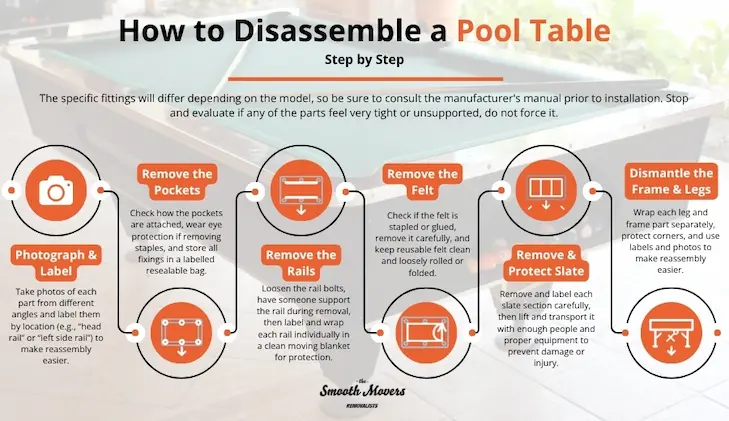
How to Disassemble a Pool Table Step by Step
The specific fittings will differ depending on the model, so be sure to consult the manufacturer’s manual before installation. Stop and evaluate if any of the parts feel very tight or unsupported; do not force it.
1. Photograph and Label the Table
Take several photos of the table from different angles before taking out each bolt. I also take close-ups of the pockets, brackets, rail positions and fixings.
Name each one by the place it is found, e.g., “head rail” or “left side rail”. When putting the table back together, labels will save a lot of time.
2. Remove the Pockets
Check under the table to discover how the pockets have been joined. They can be attached by screws, bolts or staples (depending on the model).
If using staples, wear eye protection as they may pop out at any time. Put all fixings in a labelled resealable bag – not in small pieces on the floor.
3. Remove the Rails
Check for the rail bolts under the table and carefully loosen them. When the last bolts are removed, always have another person holding the rail. This will keep it off the ground and not place pressure on other parts.
Mark the rails with the correct marking, then wrap each rail one by one with a clean moving blanket to protect the timber and cushions.
4. Remove the Felt
Firstly, decide if the felt is stapled or glued. Use a staple remover to remove them just one at a time, being careful to avoid any pulling, stretching or ripping of the cloth.
Glued felt is harder to separate without damaging the fibre and may be unsuitable for reuse. If we can preserve the cloth, keep its playing surface clean and loosely fold or roll it following the manufacturer’s directions. It should not be covered with anything.
This may also be the right time to replace felt that is faded, worn or already damaged.
5. Remove and Protect the Slate
This is the most challenging part of how to move a slate pool table. Find and pull out the screws that connect the slate to the frame. If the table is a multi-piece table, try to remove the beeswax or approved filler from each joint without harming the edges of the table.
Mark each slate section indicating its position and direction. The Smooth Movers usually do it with a simple system like “head”, “centre” and “foot” and arrows indicating the playing direction.
Even when the rest of the table has been removed, the slate sections are still quite heavy. Use appropriate lifting equipment and an adequate number of competent persons to lift each piece equally. It is never advisable to carry slate on your own.
Identify and minimise risks from heavy loads, high force and awkward postures. Transport a slate pool table in a padded crate or make a special upright frame to transport it. Tie down each component to prevent it from moving; do not place any tools, boxes or furniture on it.
6. Dismantle the Frame and Legs
Wrap legs and timber frame parts separately. Apply corner protection to completed and decorative surfaces; do not over-tighten straps to avoid leaving marks, dents or distortion in the timber.
At The Smooth Movers, we consider disassembly a component of the protection procedure. Cautionary labels, photographs and packing are all essential for moving a pool table, making delivery and reassembling much easier.
How to Pack and Protect Each Component
After table disassembly, pack each piece of the table independently. This will stop the timber from rubbing against slate and hardware when moving the pool table.
Pack Each Part Carefully
- Wrap rails, legs and frame sections individually in clean moving blankets.
- Add bubble wrap around pockets, corners and decorative details.
- Place screws, bolts, brackets and levelling parts in labelled resealable bags.
- Attach each bag to its matching wrapped component when it can be done without scratching the finish.
- Store the felt loosely folded or rolled in a clean, dry container.
- Protect slate sections with rigid padding or purpose-built crates.
When working out how to transport a slate pool table, consider that blankets are not enough to stop furniture from moving and to protect the slate from strong impacts. Don’t store tools, tool boxes or bulky objects against it.
Do not leave plastic wrap on completed timber for long periods of time, particularly in Perth’s warmer climate. Plastic can retain heat or moisture, and some finishes can be impacted. Too much heat and variation in humidity can cause real damage to materials, such as furniture.
How to Lift, Load and Transport a Pool Table
Before lifting anything, assign each person a clear role and agree on the route. One person should guide the team while others handle the load. Use lifting straps, furniture dollies and a suitable ramp wherever possible.
Lift and Load Safely
When lifting components:
- Keep fingers away from edges and other pinch points.
- Bend through the knees and hips, then use the legs to rise.
- Keep the load close to the body.
- Move the feet to turn instead of twisting the torso.
- Lower each piece together on an agreed signal.
The recommended approach for reducing hazardous lifting and carrying activities is to plan manual tasks and use mechanical aids.
Secure the slate and structural items inside the vehicle to prevent sliding, tipping or hitting. Use padded straps to provide restraint but should not be tightened so much that the finished timber is marked. Heavy furniture should never be placed near pool-table parts.
Felt, pockets and labelled hardware bags should be housed in a secure, clean hardware bag. In addition, all components are kept away from the rain and extreme heat.
Reassembling and Levelling the Pool Table
Before rebuilding the table, position the frame exactly where it will stay. Once a slate table has been assembled and levelled, moving it again can undo the adjustments.
Rebuild in the Correct Order
At The Smooth Movers, we work through these steps carefully:
- Reattach the legs and stabilise the frame.
- Check the frame across its length, width and diagonals with a spirit level.
- Return each labelled slate section to its original position.
- Level the individual pieces and seal the joins with the material approved by the manufacturer.
- Reinstall or replace the felt, keeping the tension even.
- Refit the rails and pockets using the photographs and labels taken earlier.
Installers should level the frame before installing the slate, and then complete the slate-levelling process with appropriate shims. Be sure to read the manual for the specific model you have, as instructions can differ.
Test the Playing Surface
When it is all snug, take a ball and gently roll it down the length, across the width, and towards a few corners. If it tends to sag to one side, the surface needs to be adjusted again. A slight incline can affect the flow and speed of play.
Common Pool Table Moving Mistakes
I have seen many small shortcuts taken when moving a pool table, which then become broken parts, unsafe moves and unbudgeted repairs.
Avoid these common mistakes:
- Moving a slate table intact: Its weight can strain the frame or crack the slate.
- Underestimating the weight: An uncontrolled lift may injure someone or damage the property.
- Lifting by the rails or pockets: These parts are not designed as handles and may loosen or break.
- Skipping labels: Unmarked slate sections and hardware make correct reassembly difficult.
- Mishandling the felt: Tight folds and uneven stretching can leave creases, tears or an inconsistent surface.
- Dragging the legs: This can weaken the table and scratch flooring.
- Stacking items on slate: Added weight or impact may chip or crack it.
- Using too little padding: Components can rub, shift and collide in transit.
- Forgetting destination measurements: The table may not fit through the access route or inside the room.
- Attempting stairs without suitable equipment: Heavy, awkward loads can create sudden force and increase injury risks.
- Skipping proper levelling: Even a slight slope can affect every game.
The Smooth Movers implement careful planning to make moving pool tables safer and to minimise unnecessary repair expenses.
Move Your Pool Table with the Right Preparation
Learning how to move a pool table involves far more planning than transporting ordinary furniture. The right approach depends on the table’s construction, value and the access available at both properties.
If you are completing a DIY move, put safety first. Stop if the table or slate becomes too heavy, unstable or difficult to control.
Professional pool table movers in Perth are especially helpful for slate tables, narrow access, stairs and interstate relocation.
At The Smooth Movers, we can assess your table, access route and transport requirements before moving day. Contact our team today to request a detailed assessment and pool table moving quote.

