


I have worked as a professional Perth mover for years, and I have observed every moving situation you could ever imagine.
A question that I have heard the most is, “Can you lay a fridge down to transport?” or “Can you transport a fridge lying down?” Relocation of a fridge may be a challenge, and the solution is not as simple as yes or no.
From my experience, it is possible to lay a fridge down to transport it, but it is dangerous. Only safe, with the appropriate precautions. I have assisted many families in moving appliances, and I have also witnessed what can happen when individuals move a fridge lying down and neglect to treat it carefully.
In this post, I’ll walk you through everything you need to know about transporting a fridge lying down:
- The importance of the fridge orientation.
- The possible risks to compressors and refrigerant lines when moving a fridge on its side.
- Best practice and alternatives.
This guide will help you protect your appliance and prevent costly errors.

Why Fridge Orientation Matters
Can you lay a fridge down to transport it? It can, but not without hazards. Refrigerators are made upright due to the nature of their cooling system.
It has a compressor inside, which is used to pump refrigerant over coils to cool things, and it contains oil to lubricate the moving parts. This oil is settled in where it belongs by gravity when the fridge is in an upright position. However, when you put a fridge on its back, the oil will spill out of the compressor and into the refrigerant tubes, where it is not supposed to be.
Why is that a big deal? The presence of oil in the thin cooling lines may lead to blockage that will hinder the cooling process in the fridge. In addition, as oil leaks out of its chamber, the compressor may become left running and without enough lubrication to keep it moving, which is a disaster waiting to happen when you turn the fridge back on.
In addition to fluid problems, there is physical stress. A refrigerator is not constructed to be transported lying down. The heavy parts may slide or press on other parts; thus, a shelf or a drawer may break, or the frame or doors of the appliance may shift out of alignment due to pressure.
In case you really have to lay it down, it would help to lay it on the back or on a specific side to ensure it is not damaged as much. And when the fridge is standing upright again, it is better to wait a few hours before you plug it in again.
Situations Where Laying a Fridge Down Is Unavoidable
Ideally, you would never have to lay a fridge down during a move, but there are occasions when you are left with no option. For example:
- A moving vehicle (say a small van or SUV) that is too short to allow the fridge to stand upright.
- A narrow passageway or a small door that simply cannot accommodate a standing fridge.
- A sharp bend or a small staircase requires the fridge to be transported on its side.
- The need to place the fridge flat now and then when loading or unloading to manoeuvre it safely.
If you find yourself in any of these circumstances, then you should not panic. Although the refrigerator should always be transported in an upright position, laying the refrigerator on its side for a few minutes is safe, provided some care is taken.
The point is just to be careful: lay it on one of its sides. When feasible, choose a side that keeps the door closed naturally so that gravity aids in keeping the doors closed.
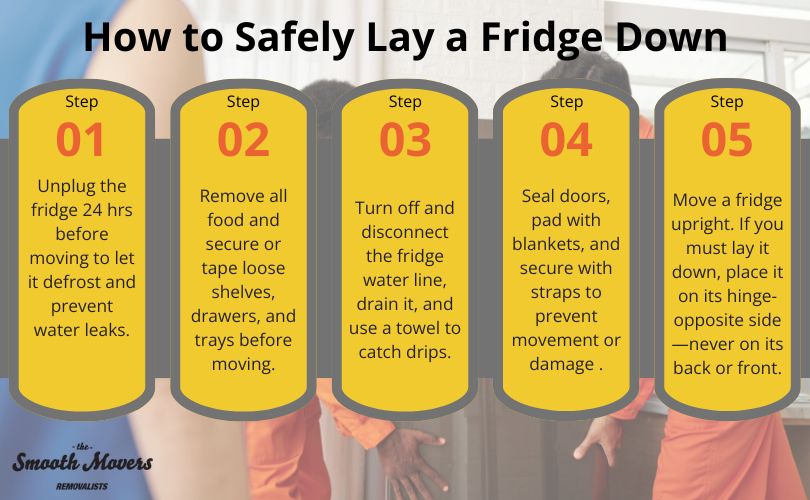
How to Safely Lay a Fridge Down
Before moving your fridge, preparation is key.
Step 1: Unplug and defrost ahead of time
At least 24 hours before the move, disconnect the refrigerator. This gives the freezer a chance to defrost, and the ice does not melt due to water leakage. (It may take up to one day to defrost a fridge after it is unplugged)
Step 2: Empty and secure the interior
Take out all food (perishables in particular) from the fridge and freezer. Clear off any loose shelves, drawers, or trays or fix them there with a streak of tape so that they will not rattle or roll around in transit.
Step 3: Disconnect water lines (if any)
If your refrigerator has an ice maker or water dispenser, turn off the water supply and disconnect the water line. Drain the line and have a towel ready to receive any drips or melted ice water. This will prevent any remaining water and cause a mess during transportation.
Step 4: Secure and protect the fridge
Lastly, secure the padded fridge in the vehicle by tying it up with strong ropes or ratchet straps. Closing the doors and padding the appliance with good fabric and straps will ensure that it remains in place and does not move or scratch.
Step 5: Keep it upright if possible – otherwise, lie on the right side
A fridge is always best moved in an upright position. This reduces the possibility of ruining the closed compressor system. When you are forced to lay the refrigerator down, put it on its side as opposed to laying it on the front or back.
Professionals suggest that it should be put on the opposite side of the door hinges, with gravity taking care of ensuring the doors remain closed. Do not put a fridge on its back or front because the compressor oil may spill out, or even break the cooling system of the unit.
What to Do After Transport
Whether you transported the fridge lying down because of space limitations or had no choice but to move a fridge on its side, the way you handle it afterwards determines its performance and lifespan.
Wait Before Plugging It Back In
Do not plug it in after transporting a fridge lying down. Lying a fridge on its back to be transported can result in the oil that is present in the compressor pouring into the cooling lines. Premature plugging may ruin the compressor or obstruct the flow of refrigerant.
Wait 4-24 hours, based on how long and how flat the refrigerator was laid. In case you need to lay a fridge on its side or transport a fridge on its back over a prolonged period of time, wait almost 24 hours. In cases of fast movements, where the fridge is tilted only briefly, 4–6 hours may be adequate.
Inspect for Potential Damage or Leaks
Once the fridge is upright:
- Look at the dents, loose wires or leaking coolant, particularly when you need to lay the fridge down to transport along uneven roads.
- Look at water lines or ice maker connections for drips. Internal parts may move even when you lay a fridge down to move it very carefully.
Test Cooling Performance Before Loading Food
When transporting a fridge on its side or laying it down for transport, this may temporarily prevent the coolant from circulating properly. Run it for a few hours and monitor the temperature. This makes sure that no hidden problems are left behind after moving a fridge.
Extra Tips
- Whenever possible, do fridges have to be transported upright? Yes, keeping it upright is the safest option. Only lay a fridge down or transport a fridge on its side if necessary.
- You may wonder which side to lay a fridge down on, so consult the manual or manufacturer; some advise laying it on the hinge side or the other way around.
These steps will help you reduce the risks even when you lay a fridge down for transportation or move a fridge on its side. Waiting for the correct time, checking for any damage, and inspecting the cooling system will further reduce the risks. This will make sure that your appliance will be in good condition after moving.

Alternative Options to Avoid Lying a Fridge Down
Although in certain cases, it is possible to move a fridge in a laying position, it is more advisable to avoid doing so. Here are smarter alternatives:
Rent or Borrow a Larger Vehicle
Think of hiring a truck or trailer tall enough for upright transport. Even the short journeys, despite being on short tilts, can still be disastrous.
Use an Appliance Dolly and Keep It Upright
An appliance dolly makes it easier to manoeuvre through doorways and staircases. Secure the fridge with straps to prevent tipping while keeping it as upright as possible.
Hire Professional Movers
Professional movers are well aware of how to move heavy appliances safely, no matter whether a short move or an interstate relocation, and therefore, you will not have to worry about whether you can lay a fridge down to transport it or move a fridge on its side. To make sure that your refrigerator is stable during loading, transportation, and unloading, movers deal with appropriate equipment, padding, and methods.
- This alternative makes the guessing of which side you lay a fridge down or how long a refrigerator can lay on its back a thing of the past.
Common Myths About Moving Fridges
We will crush two of the most widespread myths of transporting a fridge, laying down or moving a fridge on its side.
“It’s Always Safe If You Wait an Hour Before Plugging It In”
This is among the most long-lasting myths. That is not necessarily enough time. When you transport a fridge on its back for hours, oil and refrigerant may take longer to return to their correct positions.
- Reality: The professionals suggest 4-24 hours of waiting based on how long and how flat the fridge was laid. The damage to compressors that occurs when a fridge is transported on its side or laid down for transportation may not be avoided after a one-hour wait.
- In case of confusion, consult your manufacturer’s guidelines rather than guessing.
“Older Fridges Are Tougher and Can Handle Anything”
Some would believe that older appliances are indestructible and that there is nothing wrong with laying fridges down for transport or moving a fridge on its side without taking any precautions.
- Reality: Even old-fashioned refrigerators are based on compressors and refrigerant systems, which may be broken if you transport fridges lying down. Upright transportation is the safest mode of transport regardless of whether you have a new or a decades-old unit.
- Much older fridges may also be frailer due to worn-out parts; hence, transporting a fridge lying down is riskier.
Make the Process Less Stressful!
Having assisted families and businesses in transporting heavy appliances, the only advice that I can give to anyone is to ensure that a fridge is kept in the upright position whenever possible. You can lay a fridge down to transport it, but it is dangerous, and hence, all precautions should be taken.
In case you do not want to worry about whether you can lay a fridge down to transport it, The Smooth Movers can be the ones who can make the process less stressful.
After many years of experience, when it comes to moving fridges, freezers, washing machines, and other household items, our team is well-versed in how to deliver appliances safely, keeping them upright, protected, and without scratches.
Whether it’s your fridge, other appliances, or your new house, we will do it the easy, safe, and painless way. You don’t want to spend money on repairs; get the professionals to do your heavy lifting.
Contact us.

